assets
Qurbani (Udhiyah): The Animal, the Timing, the Slaughter, and the Distribution — A Complete Practical Guide
The Animal Comes First
Once you've confirmed your obligation to give Qurbani (covered in Part 1), the question becomes: What animal, what age, and what condition does it need to be in?
These are not minor details. An animal that does not meet the conditions is not a valid Udhiyah. The scholars are specific, the hadith evidence is clear, and the differences between the schools are meaningful.
Which Animals Are Valid?
Allah specified the category in the Quran: "And for every nation We have appointed religious rites, that they may mention the name of Allah over the beast of cattle that He has given them for food." (Surah Al-Hajj, 22:34)
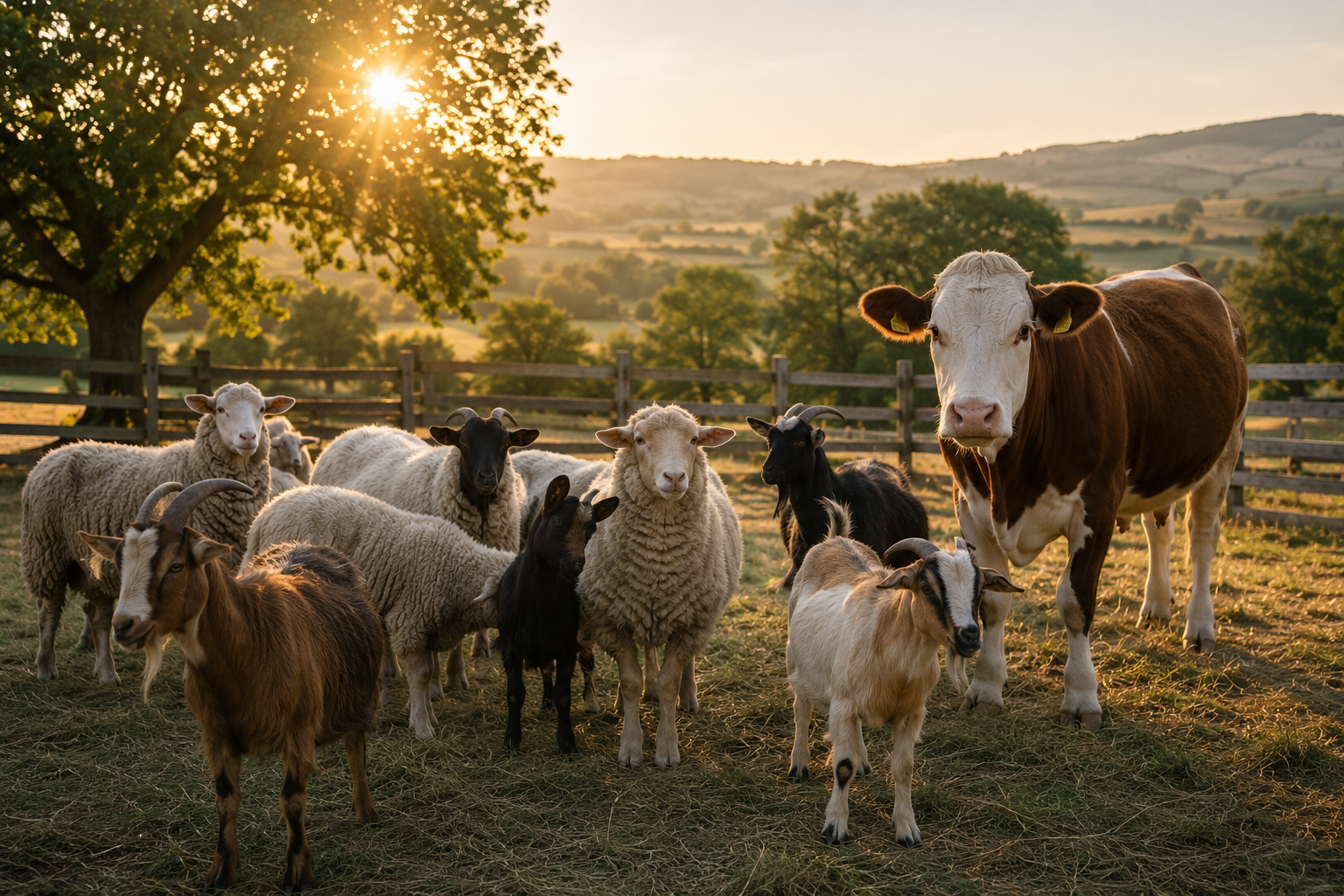
The Arabic term bahimat al-an'am (beast of cattle) refers to four species only:
- Camels (including dromedary and Bactrian)
- Cattle (cows, bulls, oxen, buffalo)
- Sheep
- Goats
All four schools agree on this list. No other animals (not horses, not chickens, not wild animals of any kind) are valid for Udhiyah, regardless of their value or the intention behind them. The Prophet ﷺ and his Companions never sacrificed any animal outside these four categories, and this practice is the binding precedent.
Male or female: Both are permissible. The Prophet ﷺ sacrificed rams, and the Companion reports mention ewes (female sheep) and she-goats as well.
How Many People Per Animal?
This is established by an unambiguous hadith. Jabir (RA) said: "We slaughtered with the Messenger of Allah ﷺ at al-Hudaybiyah a camel for seven people and a cow for seven people." (Sunan Ibn Majah)
| Animal | Covers |
|---|---|
| Sheep | 1 person |
| Goat | 1 person |
| Cow / Buffalo | 7 people (shares) |
| Camel | 7 people (shares) |
A sheep or goat cannot be split between people. A cow or camel can be shared by up to seven, and the seven shareholders do not need to be from the same family or household.
For the share to be valid, everyone sharing in a large animal must intend Udhiyah. If one person in the group of seven is only buying meat and has no intention of Qurbani, the sacrifice is invalid as Udhiyah for all seven — not just for that person.
Age Requirements — What Each School Requires
The Prophet ﷺ said: "Do not slaughter anything but a musinnah (a mature animal), unless it is too hard for you, in which case you should slaughter a jadha'ah (young sheep)." (Sahih Muslim, 1963)
A musinnah is an animal that has reached full maturity as defined by its teething stage. The jadha'ah exception applies only to sheep in cases of need. This hadith is the foundation for the age requirements across all four schools.
Sheep
| School | Minimum Age |
|---|---|
| Hanafi | 6 months, if it appears as large and developed as a 1-year-old from a distance. Otherwise, 1 year. |
| Maliki | 1 year completed, entered the second year (though some Maliki scholars permit a plump 6-month-old) |
| Shafi'i | 1 year completed, entered the second year |
| Hanbali | 6 months always valid, without the size condition |
The 6-month sheep (jadha'ah) is the only exception to the general maturity rule. It does not apply to goats, cows, or camels. A six-month-old goat is not valid as Udhiyah in any school.
Goats
| School | Minimum Age |
|---|---|
| Hanafi | 1 year completed |
| Maliki | 1 year completed |
| Hanbali | 1 year completed |
| Shafi'i | 2 years completed |
Cows and Buffalo
| School | Minimum Age |
|---|---|
| Hanafi | 2 years completed |
| Shafi'i | 2 years completed |
| Hanbali | 2 years completed |
| Maliki | 3 years completed |
Camels
All four schools agree: 5 years completed, entering the sixth year.
A Practical Warning
Sellers — particularly in livestock markets during Eid season — sometimes claim an animal is "almost" the required age. Do not accept "almost." An animal that has not completed the minimum age is not valid as Udhiyah, regardless of its size or appearance. Verify the age. If you're using a reputable Qurbani organization, ask how they verify animal ages.
The Four Defects That Invalidate the Sacrifice
The Prophet ﷺ was asked what should be avoided in sacrificial animals. Al-Bara' ibn 'Azib (RA) narrated the answer:
"Four (types of animals) should be avoided in sacrifice: A one-eyed animal whose defect is obvious, a sick animal whose sickness is obvious, a lame animal whose limp is obvious, and an emaciated animal that has no marrow in its bones." (Ibn Majah, 3144)
All four schools apply these as disqualifying conditions. An animal with any of the following cannot be used as Udhiyah:
1. Obviously one-eyed. This includes an eye that is sunken, protruding, or clearly white and blind. A minor cloudiness does not disqualify the animal; obvious, apparent loss of sight in one eye does.
2. Obviously sick. An animal with a fever that prevents it from grazing, mange (a skin disease caused by parasitic mites) that clearly affects its flesh or health, or deep wounds affecting its wellbeing. A minor illness or injury that does not affect the animal's overall health does not disqualify it.
3. Obviously lame. An animal that cannot walk normally and keep up with the herd. A minor limp that does not prevent normal movement does not disqualify.
4. Severely emaciated. An animal so thin that it has no marrow in its bones — the kind no one would choose to buy for food. An animal that is lean but otherwise healthy is not in this category.
Additional Defects That Make Sacrifice Disliked (Makruh)
The scholars added the following as makruh (disliked, but not invalidating) based on the principle that any defect diminishing the animal's value is undesirable:
- Missing more than half an ear or horn
- Ears slit crosswise
- Teats removed or damaged
- Any defect similar in severity to the four above
After the hadith described the four major defects, al-Bara' ibn 'Azib was asked about defective teeth and horns. He replied: "Leave what you dislike, but do not make it prohibited for anyone." This indicates that tooth and horn defects fall into the makruh category rather than outright prohibition.
What to Look for in a Good Animal
In Sahih al-Bukhari (5558), Anas (RA) narrated that the Prophet ﷺ sacrificed two horned rams that were white speckled with black, placing his foot on their sides while reciting the name of Allah and saying Takbir (Allahu Akbar). (Sahih al-Bukhari (5558)
Fat, healthy, physically complete animals are the standard. Abu Sa'id al-Khudri (RA) reported the Prophet sacrificed a whole, horned, healthy male sheep with distinctive markings (the four Sunan; classed as sahih by al-Albani in Sahih Abi Dawud, 2796).
The scholarly consensus on the best types: Camels, then cows (if dedicated to one person), then sheep, then goats.
Timing: When the Sacrifice Begins and Ends
When It Starts
The Udhiyah cannot be slaughtered before the Eid prayer. The Prophet ﷺ said: "Whoever slaughters before the prayer, it is meat that he has brought to his family, but that is not the sacrifice." (Muslim, 1961)
There is a slight difference between the schools on the precise start:
- Hanafi: For city dwellers (who attend an imam-led Eid prayer), the time begins when the Eid prayer is completed. For those in villages or areas without an imam-led prayer, the time begins at the break of dawn on the 10th of Dhul Hijjah.
- Maliki: Begins after the Eid prayer and the sermon (khutbah), after the imam has slaughtered his own sacrifice.
- Shafi'i and Hanbali: Begins after the Eid prayer.
If you are giving Qurbani through an organization overseas, they will determine the start time based on the local conditions of where the slaughter takes place — not where you are.
When It Ends
- Hanafi, Maliki, Shafi'i: Sunset of the 12th of Dhul Hijjah. This gives three days total: the 10th, 11th, and 12th.
- Hanbali: Sunset of the 13th of Dhul Hijjah — four days total, including the last day of the Tashriq days.
The Hanbali evidence: The Prophet ﷺ said "The days of al-Tashriq are days of eating, drinking, and remembering Allah." (Muslim) Since the 13th is included in the Tashriq days, the Hanbali position extends the window through that day.
Any slaughter after the deadline does not count as Udhiyah. It is ordinary meat.
How to Perform the Slaughter
The Obligation: Proper Islamic Slaughter
The animal must be slaughtered according to Islamic dhabh: A swift, deep cut severing the jugular veins, carotid arteries, and esophagus. The name of Allah must be said.
Best Practices — Established by the Sunnah
It is best to slaughter the animal yourself. The Prophet ﷺ slaughtered with his own hand (Muslim, 1966). Ibn al-Qayyim writes in Zad al-Ma'ad that the Prophet ﷺ never neglected the sacrifice and always slaughtered after the Eid prayer. Doing it yourself is closer to the spirit of the act.
Delegating is fully permissible. The Prophet ﷺ delegated some of the Hajj sacrifice to Ali (RA) during his Farewell Pilgrimage. Giving Qurbani through a trustworthy organization or person is valid. If you delegate, your intention (niyyah) must be set at the time of delegation — before the animal is slaughtered, not after.
If you delegate, it is recommended to witness the sacrifice if possible. The Prophet ﷺ said to Fatimah (RA): "O Fatimah, go to your sacrifice and witness it." (Cited in al-Fiqh al-Islami wa Adillatuhu, 4/237; the four schools are unanimously agreed on this recommendation)
Face the animal toward the Qiblah. This is the recommended practice.
Use a sharp knife. The Prophet ﷺ commanded: "Sharpen your blades and treat the animals well." (Muslim) Blunt knives cause unnecessary suffering. Sharpen the knife before bringing it near the animal. Do not sharpen it in front of the animal. Do not slaughter one animal in front of another.
What to say at the time of slaughter:
Say: Bismillah, Allahu Akbar (In the name of Allah, Allah is the Greatest).
The recommended supplication, narrated by 'Aisha (RA), is what the Prophet ﷺ said as he sacrificed: "In the name of Allah. O Allah, accept this from Muhammad, the family of Muhammad, and the Ummah of Muhammad." (Muslim)
If sacrificing on behalf of another person, name them: "O Allah, accept this from [name]."
Distributing the Meat
The Quran instructs: "...eat thereof and feed the afflicted and the poor." (Surah Al-Hajj, 22:28) And: "...eat of them and feed the self-restrained needy and the suppliant poor." (Surah Al-Hajj, 22:36)
The recommended division, adopted by Ibn Mas'ud, Ibn Umar, and Imam Ahmad (narrated from Ibn Abbas, classed as hasan by Abu Musa al-Asbahani):
- One third for yourself and your household
- One third as gifts to neighbors, relatives, and friends (regardless of their financial status)
- One third in charity to the poor and needy
This is the recommended distribution, not a strict obligation. The Udhiyah remains valid if you distribute differently, as long as some portion reaches the poor. Ibn Baaz's Permanent Committee stated: "The manner of distributing it, whether cooked or raw, is open to discretion. What is specifically legislated is that it should be eaten from, given as gifts, and given in charity." (Bakkah.net, Permanent Committee Fatwa 11/403)
A note on the charity portion: Giving raw meat to the poor so they can take it home is better than inviting them to a shared meal. The purpose is to give them food they can use, not to host them.
Giving to non-Muslims: Ibn Qudama confirmed: "It is permissible to give some of the udhiyah to a disbeliever." (Al-Mughni (Volume 9)) This is the view of al-Hasan, Abu Thawr, and others. Voluntary charity is not restricted by religion.
What You Cannot Do
You cannot sell any part of the sacrifice. Not the meat, not the skin, not the fat, not the bones, not the wool.
You cannot pay the butcher with meat from the sacrifice. Ali (RA) narrated: "The Messenger of Allah ﷺ ordered me to watch over the camel while it was slaughtered and to distribute its meat and skin, and he ordered me not to give the butcher anything from it, saying: 'We will give him his fee separately.'" (Bukhari) You pay the butcher from your own money. You may give him some meat as a gift or charity if he is poor.
Giving Qurbani Through an Organization or Overseas
Delegating Is Valid
Appointing a trusted agent (tawkil) to slaughter on your behalf is fully permissible — this is established practice going back to the Prophet ﷺ himself delegating during Hajj. When you pay a charity or organization to handle your Qurbani, your intention is set at the moment of payment and delegation. The slaughter is performed in your name.
Overseas Qurbani
Sending your Udhiyah to another country is a matter on which the classical and contemporary scholars differ.
Classical Hanafi position: It is makruh (disliked) to transfer the Udhiyah from the donor's land to another land, similar to the ruling on Zakat, unless one is transferring it to relatives. (Dr. Wahbah az-Zuhayli, al-Fiqh al-Islami wa Adillatuhu, 4/282)
Contemporary majority position: A number of contemporary scholars, including Shaykh Ibn Jibrin and others, hold that it is permissible to give Udhiyah in another country, particularly when the need there is significantly greater. The reasoning: If Zakat — which is obligatory by consensus — may be transferred to a land of greater need, then Udhiyah (which is sunnah for the majority of schools) may certainly be sent where it is more impactful. (IslamQA, answer 175475)
The practical guidance for most Muslims: Giving Qurbani through a reputable Islamic relief organization that slaughters abroad is valid and widely supported by contemporary scholars. The condition is that the organization is trustworthy, slaughters within the valid time window, uses animals that meet the age and health requirements, and distributes the meat to those who genuinely need it.
Many Muslims choose to do both: Perform or commission a local sacrifice for their household's benefit (sharing the meat with neighbors, local mosques, and the poor nearby), and additionally give through an overseas organization for those in dire need in conflict zones or famine-affected countries.
Qurbani on Behalf of the Deceased
This is a matter on which the schools differ:
- Hanafi and Hanbali: Permissible to sacrifice on behalf of a deceased person, with the same meat distribution rules.
- Maliki: Disliked unless the deceased specifically bequeathed it before death.
- Shafi'i: Not permissible without a bequest from the deceased. If bequeathed, all the meat must go to the poor; the family cannot eat from it.
The Prophet ﷺ slaughtered one of his rams saying: "In the name of Allah and Allah is Greatest. This is on my behalf and on behalf of those of my Ummah who did not sacrifice." (Abu Dawud) This is cited as evidence that sacrifice for the deceased — and even for those who did not sacrifice — is permitted.
What Invalidates the Qurbani
| Scenario | Ruling |
|---|---|
| Slaughtered before the Eid prayer | Invalid — counts as ordinary meat only |
| Slaughtered after the deadline (after sunset 12th, or 13th for Hanbali) | Invalid |
| Animal under minimum age | Invalid |
| Animal has one of the 4 major defects (one-eyed, sick, lame, emaciated) | Invalid |
| Selling any part of the animal | Invalidates the entire sacrifice |
| Animal not owned by the sacrificer (stolen, borrowed without permission) | Invalid |
| Paying the butcher with the animal's meat | Not permissible; the sacrifice remains valid but the act is sinful |
| Giving all shares to intend Qurbani, except one person buying meat | Invalid for all seven sharers |
| Cutting hair or nails before sacrifice (if you intended to avoid it) | Does not invalidate — only makruh; slaughter is still valid |
Frequently Asked Questions
Q: I'm giving Qurbani through an organization this year. Do I still avoid cutting my hair and nails? Yes, if you have set the intention to give Qurbani, the recommendation to avoid hair and nails from the 1st of Dhul Hijjah applies to you personally, regardless of whether you slaughter yourself or delegate it.
Q: Can one share of a cow cover me and my whole family? In the Maliki, Shafi'i, and Hanbali schools: One animal (whether sheep, goat, or one-seventh share of a cow) covers you and your household. In the Hanafi school: each eligible member of the household gives their own Qurbani.
Q: Can I give more than one Qurbani? Yes. Giving additional Qurbanis beyond what is obligatory or recommended is a nafl (supererogatory) act of worship. Many Muslims sacrifice on behalf of the Prophet ﷺ, on behalf of deceased relatives, or for extra reward. All of this is established and praiseworthy.
Q: What if I'm on Hajj — do I still give Udhiyah? No. The sacrifice during Hajj is called Hady, which has its own separate rulings and is performed at the Haram. If you are performing Hajj Tamattu' or Qiran, the Hady is obligatory on you. You do not perform a separate Udhiyah while on Hajj.
Q: Can I eat from the Qurbani meat myself? Yes. Eating from the Udhiyah is recommended (mustahabb). The Shafi'i school suggests eating a few morsels — ideally from the liver — as that was the Prophet's practice. The majority say you may eat as much as you like, while ensuring the charity portion reaches the poor.
Q: I missed several years of Qurbani. What do I do? If you follow the Hanafi school: Calculate each year you missed and give the monetary equivalent of a sheep's value in charity for each year. Do this as soon as possible. If you follow the Maliki, Shafi'i, or Hanbali school: There is no formal makeup since Udhiyah is sunnah, but giving additional Qurbanis this year with the intention of making up past years is encouraged and carries reward.
Closing Thought
Ibrahim (AS) was prepared to give up the most precious thing in his life. What Allah kept was not the act itself, but the intention behind it: "Their meat will not reach Allah, nor will their blood, but what reaches Him is piety from you." (Surah Al-Hajj, 22:37)
The conditions in this guide — the age, the health, the timing, the distribution — exist to ensure the act is done correctly, with care, and in a way that genuinely benefits the poor. An Udhiyah done properly is not a transaction. It is a gesture of nearness.
May Allah accept your sacrifice, bless your family, and make this Eid al-Adha a source of real barakah for you and for those who receive the meat. Ameen.
Part 1 of this guide covers what Qurbani is, its Quranic basis, the ruling across all four madhabs, who is eligible, and how to handle missed years.
Related articles

Qurbani (Udhiyah): The Sacrifice of Eid al-Adha — What It Is, Who Owes It, and What Happens If You Miss It
What is Qurbani and who is required to give it? Learn the basis, the ruling across the madhabs, who qualifies, if one sacrifice covers a whole household, and what to do if you've missed in past years.
How to Calculate Zakat: The 5th Condition, Nisab Thresholds, and the Simple 2.5% Formula
Learn the 5th and final condition for Zakat, how to determine your Nisab threshold, how to handle fluctuating wealth and debt, and how to calculate exactly how much Zakat you owe in 2026.
Zakat Explained: What It Is, Why It Matters, and How to Know If You Owe It
Learn everything you need to know about Zakat — its meaning, the 4 key conditions that make it obligatory, nisab thresholds for 2026, and the most common mistakes Muslims make when paying it.